%202_e.png)


Starliner’s Bumpy Ride: Boeing’s Delayed Leap into Human Spaceflight

By Joshua Wang,
The Lawrenceville School
For nine years after the last flight of the space shuttle on July 21, 2011, NASA depended on the Russian Soyuz spacecraft to send astronauts and scientists to the International Space Station (ISS). In 2014, as an effort to promote cost-effectiveness, competition, and independence from foreign space organizations, NASA awarded US companies Boeing and its competitor, SpaceX, with contracts to develop new systems for ISS transportation. Today, the Boeing Starliner utilizes the newest innovations to submit to NASA’s goals; however, despite the advanced technologies and years of dedicated work, the Starliner stands at a critical crossroads, facing further testing and addressing unresolved failures.

In 2010, NASA announced its Commercial Crew Program (CCP) with the aim to provide “safe, reliable, and cost-effective human transportation to and from the International Space Station from the United States through a partnership with American private industry” (Commercial Crew Program). NASA’s current contracts leading to Boeing’s Starliner and the SpaceX Crew Dragon are the first major steps for the program, with Boeing’s and SpaceX’s role to design safe and economical crew capsules to be launched and docked at the ISS.
When creating crew capsules, Boeing and SpaceX follow drastically different design philosophies. Structural advantages of the Boeing Starliner include its ability to land on terrain and water; a large pressurized cargo hold with a wider capsule design; and the capability to use multiple launch vehicles including the Atlas V rockets, Falcon 9, Vulcan Centaur, and more. However, the Crew Dragon bolsters its ability to fly autonomously for 10 days compared to Starliner’s 2.5, though possessing a smaller and limited pressurized cargo hold and a non-pressurized service module hold. Still, the greatest advantage of the Starliner is its non-welded frame, granting the spacecraft not only substantial durability over SpaceX’s counterpart, but also a reduction of mass. Continuing to interior design, the differences between Boeing and SpaceX are further emphasized as Starliner boasts a classic modern cockpit layout with both tactile switches and touchscreens, while SpaceX prioritizes a minimalistic, sleek, and ergonomic touchscreen-only design, creating the sense of a roomier capsule despite the smaller physical size (Starliner Vs Dragon). Regardless of design choices, the Starliner and Crew Dragon both represent the newest technologies of the present-day with complex systems and redundancies to yield astronauts security.
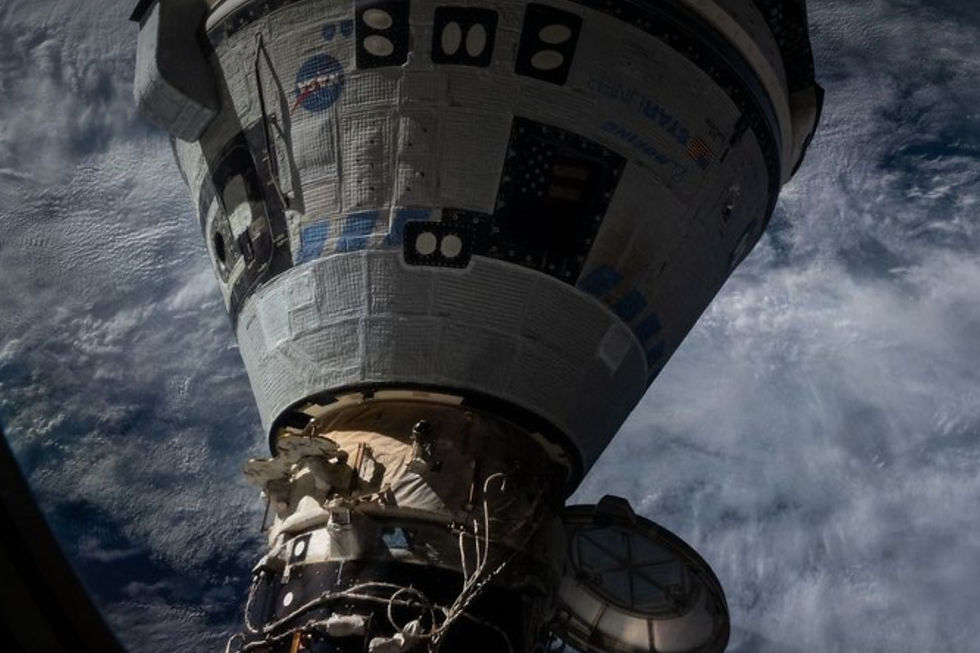
Though the advancements of the Starliner have provided hope for Boeing and the industry, the most recent spaceflight of the Boeing Crew Flight Test mission (CFT) saw multiple serious failures and issues. Before the launch on June 6, 2024, one helium leak was already discovered on the Starliner. Yet, the CFT mission continued with its launch of the spacecraft and 2 crew members. Upon reaching orbit, four separate helium leaks occurred. However, the most dangerous issue arose when the Starliner attempted to approach the ISS for docking, where 5 out of 8 of its rear-facing reactionary control system (RSC) thrusters failed, inhibiting the spacecraft to make precise attitude adjustments to align with the ISS (Buntz). Though Starliner successfully docked with the ISS in the end, the significant failures of the spacecraft and its near catastrophe with human souls aboard raises major concerns over NASA and Boeing’s manufacturing and testing facilities.
Starliner’s journey since its first test flight in 2019 has been riddled with serious complications and delays. In 2019, the first Starliner Orbital Flight Test 1 (OFT-1) failed to reach the ISS after software issues prevented the spacecraft from continuing anonymously, prompting 80 corrective actions identified by an independent review. NASA’s 2020 Aerospace Safety Advisory Panel (ASAP) report stated that “the Starliner system encountered several software-driven problems that threatened its operation and could have resulted in loss of the spacecraft,” prompting further delays in future test flights and production. Prior to the CFT mission, OFT-2 also encountered major technical issues and faulty thrusters hindered docking to the ISS. When the CFT mission launched in 2025 on June 5, problems from past test flights still had not been completely resolved, leading to thruster failures from overheating of teflon seal components, and stranding the two astronauts in the ISS. As engineers on the ground attempted to diagnose the failures, the crew-members expected return on June 14 was delayed. Around 9 months later on March 18, 2025, the crew members of the CFT mission landed safely back on Earth on a SpaceX Crew Dragon, 277 days overdue (Kekatos).

Through repeated failures, Starliner has suffered major setbacks for both Boeing and NASA, questioning the legitimacy of Boeing’s processes and safety standards. In the same ASAP report by NASA in 2020, the panel had identified that “there is no single test facility that can perform end-to-end, integrated avionics and software integration and testing” and “the Panel will be closely following the efforts by NASA and the AES program office to address concerns over end-to-end integrated software test capabilities.” Yet, despite all alleged monitoring of Boeing and NASA’s efforts in increasing testing quality and standards, the Starliner has seen limited improvements, leading to the detrimental delays following the CFT mission.
As of now, technical issues continue to delay the next test flight, now expected in early 2026, with the starliner having completed no successful commercial operation since its awarded contract in 2014. SpaceX, in comparison, has completed more than 10 successful commercial flights to and from the ISS, considerably out-performing Boeing in both safety and reliability (Starliner Vs Dragon). With the Crew Dragon, NASA’s CCP continues to complete missions at the ISS, awarding the program success despite Boeing’s continuous impediments. NASA hopes to find success with the Starliner soon to push their program further and adopt more American-made spacecraft for orbital ISS missions.

Although the Starliner offers many benefits and advantages compared to the Crew Dragon, Boeing has faced obstacles that have slowed down their debut into the commercial aerospace field. Struggling with systemic errors in their design and testing processes, Boeing’s future in aerospace has come to a standstill until the Starliner is rectified. The possibilities for Boeing in aerospace are endless with emerging demand for tourist space travel, cargo operations, etc. Additionally, because Starliner helps employ 425 different suppliers from 37 US states, the future of Boeing in space travel will be necessary to develop the US economy and provide further competition in the sector against SpaceX. As space becomes a tangible location for both scientists and common citizens alike, Boeing must address the major flaws in their facilities to become a dominant competitor in the new and expanding US market for commercial space travel.
References
Aerospace Safety Advisory Panel. Aerospace Safety Advisory Panel Annual Report for 2020. National Aeronautics and Space
Administration, Jan. 2021. NASA, oiir.hq.nasa.gov/asap/documents/2020_ASAP_Report-TAGGED.pdf. Accessed 5 Oct. 2025.
Buntz, Brian. "Newly revealed details on Boeing Starliner's mission highlight systemic engineering challenges." R&D World, 4 Apr. 2025,
www.rdworldonline.com/newly-revealed-details-on-boeing-starliners-mission-highlight-systemic-engineering-challenges/. Accessed 5 Oct. 2025.
"Commercial Crew Program Essentials." NASA, www.nasa.gov/humans-in-space/commercial-space/commercial-crew-
program/commercial-crew-program-essentials/. Accessed 5 Oct. 2025.
Kekatos, Mary. "Timeline of Boeing's Starliner mission that left NASA astronauts aboard ISS for 9 months." ABC News, 18 Mar. 2025,
abcnews.go.com/US/timeline-boeings-starliner-mission-left-nasa-astronauts-aboard/story?id=119867727. Accessed 5 Oct. 2025.
"Starliner Vs Dragon: The Ultimate Face-off for Space Primacy." Orbital Today, 5 July 2025, orbitaltoday.com/2025/07/05/boeing-
starliner-vs-spacex-dragon-comparison/. Accessed 5 Oct. 2025.


Comments