%202_e.png)


Google’s New Quantum Chip Willow: Does the Multiverse Exist?
- TechTrek Admin

- Mar 1, 2025
- 4 min read
Updated: Apr 22, 2025
By Oceana Li
Technology Columnist; The Lawrenceville School, NJ
Classical computers would have taken ten-septillion years or ‘the age of the universe’ to solve the random circuit sampling benchmark problem. Willow took 5 minutes. On December 9th, Google debuted their most recent quantum processor, Willow, a 105-qubit chip that can solve complex calculations exponentially faster than previous quantum chip models. The key component to this new technology is quantum error correction, which Google implemented to increase the number of qubits in the chip without consequently increasing the rate of error. The tech company had a similar breakthrough in 2019, when their most advanced quantum computer at the time took 200 seconds to solve a complex problem that would have taken the leading supercomputer Summit 10,000 years. After this significant advancement, Google claimed “quantum supremacy” in 2019, in which a quantum computer remarkably outperforms or is able to solve a problem that classical computers can not solve. The key advantage of quantum computation is being able to simulate multiple outcomes and conduct numerous calculations at once. This ability and Willow’s profound performance have led experts to believe quantum computing is touching upon the multiverse. Under its current trajectory, technology experts predict a future where quantum computers dominate traditional computers as the technology will be increasingly relevant in a multitude of fields ranging from artificial intelligence to environmental science.

Image of Willow, Google’s Quantum Chip
As traditional computers are reaching their physical limits, tech companies like Google are pursuing quantum computers. This includes the development and production of quantum chips which contain quantum bits or “qubits”, a key difference from traditional chips that give them an advantage in performing complex tasks. While traditional computers use bytes, which consist of bits that switch between zero and one, qubits take advantage of a principle known as “superposition” in which it is able to take on more than one state at a time. Superposition allows for the testing of multiple possibilities at once, thus accelerating the process of making predictions and performing complex calculations. For example, Willow, a quantum processor by Google, accomplished a task that shocked quantum physicists and the tech world. The random circuit sampling benchmark is the most challenging problem used to measure the computational power of classical computers. Willow solved the problem in a mere 5 minutes, an outstanding accomplishment compared to what would have taken classical computers 10^25 years, longer than the history of the universe. This performance has led tech experts to theorize that Willow must have harnessed energy from another universe to perform this complex calculation in such a short time, proving the existence of parallel universes. The idea of a multiverse believes that when we make decisions, every possible outcome happens, each in its own different universe. Similarly, a quantum computer performs multiple computations at once in parallel universes. British physicist David Deutsch explains the involvement of the multiverse in quantum computing, “Each computation takes place in a distinct branch of reality, and the quantum computer effectively leverages this multiplicity to solve problems that are impossible for classical computers.” (Swayne 24). Following this breakthrough, further proof of the existence of the multiverse through quantum computing may proliferate the development of alarmingly powerful technologies.
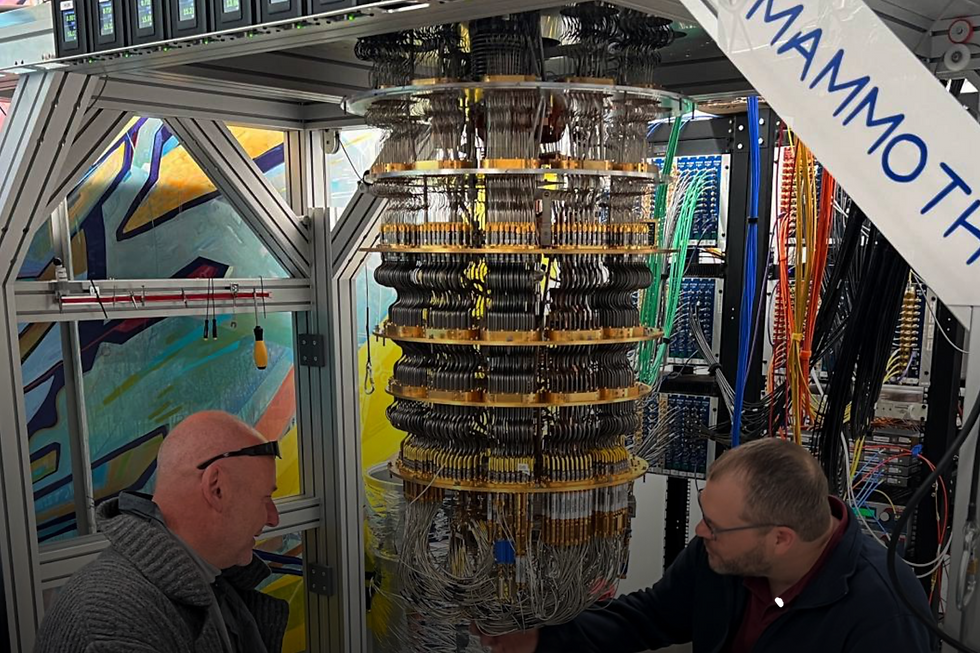
However, a disadvantage in developing and using quantum chips is fragility. Given the intricacy of each qubit, even the smallest changes in the physical environment could cause errors in the quantum computing process. Thus, its sensitivity to error continues to complicate the applicability of the quantum chip. Still, the recent debut of Willow exemplifies rapid improvements and innovations in the quantum computing field. Willow uses more qubits to reduce error, contrary to the prior problem that limited the scalability of quantum chips: more qubits create more room for error, thus incurring a high rate of error. Through a process known as “quantum error correction”, Willow overcomes this challenge by grouping physical qubits into a “logical qubit” which increases the chip’s tolerance to errors. Google tested a 3x3, 5x5, and 7x7 logical qubit, and found per every increase in surface code lattice, overall error was minimized by a factor of two (Newman et al. 2024). The unique structure and components of a logical qubit explain this contradictory behavior. In Willow, each logical qubit contains “measure qubits” which identify any anomalies in nearby qubits, allowing for the correction of the error. Although still in its infancy, Willow and quantum error correction are huge advancements toward a reality in which quantum computation is truly applicable.

Some individuals view this major advancement as a threat, fearing the potential malicious use of this technology. Having the ability to test multiple possibilities simultaneously could be useful in decrypting and breaking security systems to acquire sensitive data. More specifically, there is a concern that bad actors may utilize the quantum chip to decrypt Bitcoin’s encryption (Pessarlay 2024). Fortunately, such threats remain unrealistic and hypothetical as such a task would require millions of qubits, a substantial number in comparison to Willow’s 105 qubits. Therefore the prospect of developing a quantum computer capable of breaching the complex encryption of Bitcoin would take at least decades.
Even for benevolent uses, the limitation of scaling must be addressed before quantum computing can appear in any real-world applications. Its potential stretches from the field of cybersecurity to even addressing issues like climate change. Companies are shifting their focus to the innovation and development of quantum technology to make these applications a reality. Whether this takes decades or even a few years is not definite because, as Willow’s breakthrough demonstrated, advancements in this field are unpredictable.
----Works Cited
Arjun Kharpal. “Google Claims Quantum Computing Milestone — but the Tech Can’t Solve Real-World Problems Yet.”
CNBC, 10 Dec. 2024, www.cnbc.com/2024/12/10/google-claims-quantum-milestone-but-cant-solve-real-world-problems-.html.
Bajarin, Tim. “Why Google’s Quantum Computer Chip Willow Is a Game Changer.” Forbes, 13 Dec. 2024,
Moss, Sebastian. “Google Claims Quantum Supremacy.” Data Center Dynamics, 2024 DCD, 23 Sept. 2019,
www.datacenterdynamics.com/en/news/google-claims-quantum-supremacy/. Accessed 23 Dec. 2024.
Neven, Hartmut. “Meet Willow, Our State-of-The-Art Quantum Chip.” Google, Google, 9 Dec. 2024,
Newman, Michael, and Kevin Satzinger. “Making Quantum Error Correction Work.” Google Research, Google, 2024,
Rupani, Pratik. “LinkedIn.” Linkedin, Linkedin, 2024, www.linkedin.com/pulse/drawbacks-googles-willow-quantum-chip-
pratik-rupani-p3xof. Accessed 23 Dec. 2024.
Swayne, Matt. “Google’s Quantum Chip Sparks Debate on Multiverse Theory.” The Quantum Insider, Resonance, 16 Dec.
2024, thequantuminsider.com/2024/12/16/googles-quantum-chip-sparks-debate-on-multiverse-theory/. Accessed 23 Dec. 2024.
Wahid Pessarlay. “Google Unveils “Willow”; Bernstein Downplays Quantum Threat to Bitcoin.” CoinGeek, CoinGeek, 18
Dec. 2024, coingeek.com/google-unveils-willow-bernstein-downplays-quantum-threat-to-bitcoin/. Accessed 23 Dec. 2024.


Comments